Introducing Red Bunny and Blue Bunny!

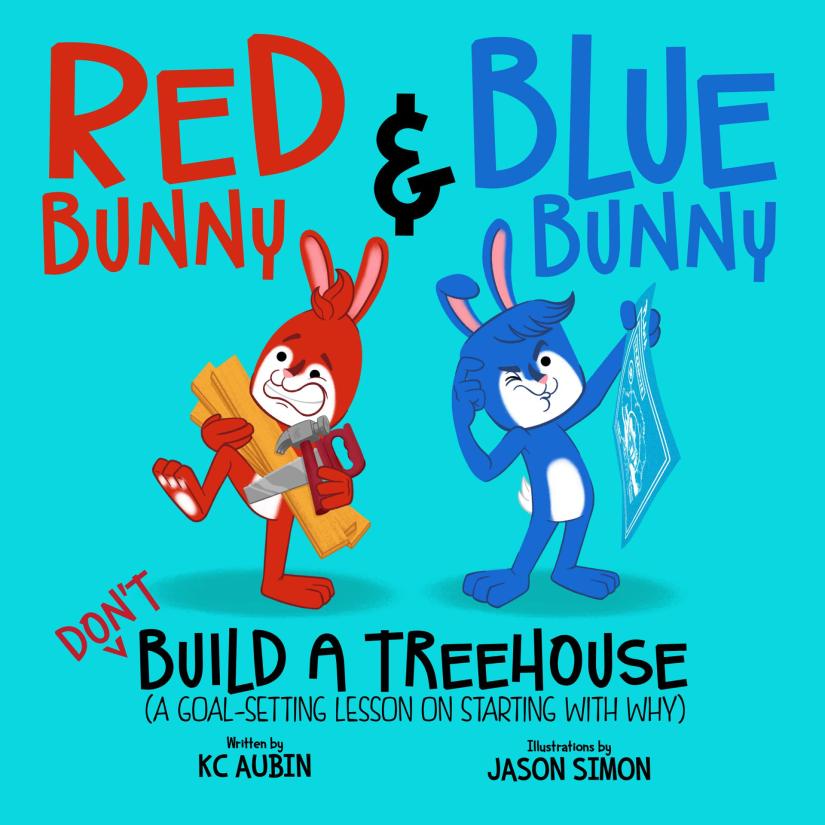
It’s here! Red Bunny and Blue Bunny (Don’t) Build a Treehouse (A Goal-Setting Lesson on Starting with Why) is now available for purchase on Amazon!

Look at that gorgeous cover! Doesn’t it just grab your attention right away? The bunnies are so cute and so full of character… You can’t help but feel charmed by them!

A number of people went into making this book possible… Jason Simon, the incredible illustrator who brought an amazing amount of skill and creativity in providing life and character to Red Bunny and Blue Bunny. Rebecca McKinney, the exceptional editor who not only provided editing services, but suggestions (and support!) that made the book so much better than what I originally sent her. My husband, who supported my dream from the beginning and let me bounce every bad idea I had off of him, while also never complaining about the countless drafts I made him read through. And my beautiful children, who listened to version after version of the story and made me feel like the stories were worth sharing with others.

If you picked up a copy of Red Bunny and Blue Bunny (Don’t) Build a Treehouse (A Goal-Setting Lesson on Starting with Why), thank you! I hope you enjoyed reading it. I certainly enjoyed writing it! And for more Red Bunny and Blue Bunny fun, I’ve got an Activity Pack I created to go along with the book that you can print out and share with your kids.

Hope to see you again next time, when Red Bunny and Blue Bunny (might) meet their hero, Captain Carrot!

Until then, thanks for reading!

KC

Albert Adds Up! – An approachable addition and subtraction lesson-in-a-story for kids

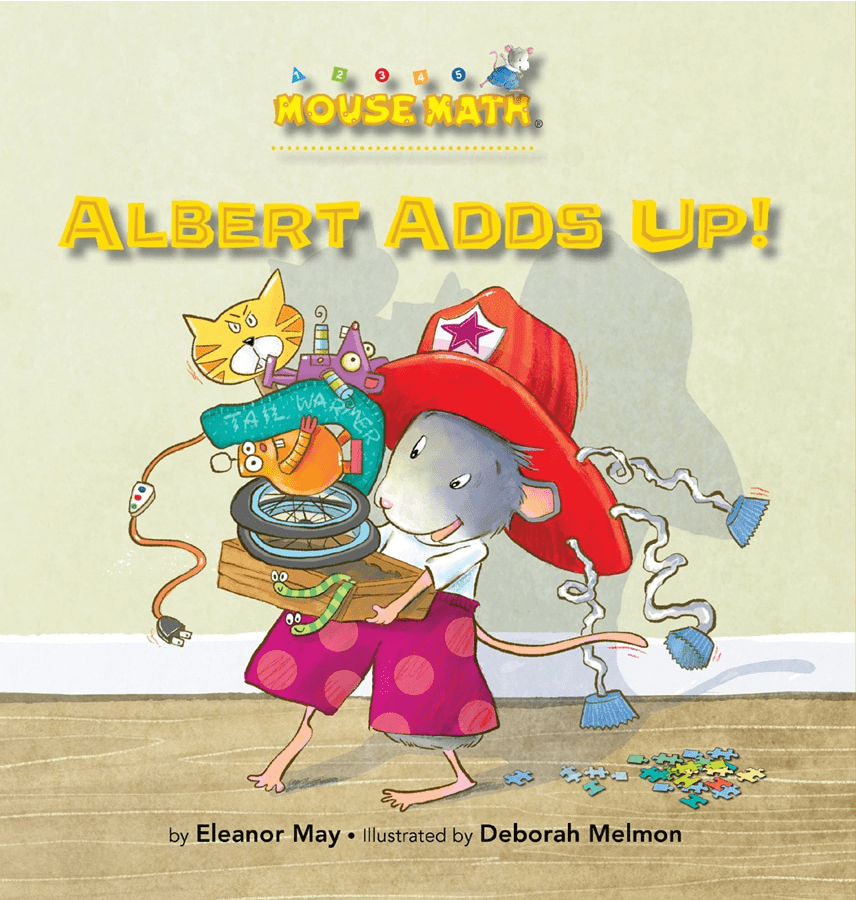
Math is boring. Or is it? In the super-cute and fun Albert Adds Up!, kids can get a realistic math lesson neatly layered within an engaging story.

Albert Adds Up! starts with Albert’s sister Wanda returning from the library with a book Albert wants to read. Albert immediately starts offering his toys to Wanda to trade in exchange for reading it first, adding more and more items to his trade pile. Several pages include illustrations with pictures and numbers that show how big Albert’s trade pile is growing so kids can correlate the number of toys with the actual numbers. Eventually, Wanda insists Albert starts taking toys away, and the subtraction starts, until Albert’s trade pile is reduced to zero.

My favorite part of this book was the interaction between Wanda and Albert. As Albert is continually trying to add items to trade to Wanda, she keeps trying to tell him she got the book for him, but gets distracted by the items he’s adding and asking him questions about them in a very cute way. Her distraction enables Albert to continue adding items to his trade pile, because he thinks “it’s not enough” for her to let him read the book first. I don’t like to use the term organic because for a while it got very over-used, but because of the sibling’s interactions, his trade pile is able to grow in a very organic way, allowing the math concepts to continue through the story.

I also have to give incredible kudos to the author and illustrator. They were able to create realistic and likeable characters that you could really understand in a math story! It’s so impressive. And, on top of the math lesson, there’s also a hidden lesson in the story about not interrupting and letting someone finish what they’re saying. Genius!

I will definitely be checking out more of the Mouse Math series, and I would highly encourage you to do the same!

You can download our lesson plan as a .pdf or read it below. I’ve also included links in the lesson plan to some materials I created for the activities.

Lesson

Albert Adds Up!

Albert Adds Up! (Amazon)

Vocabulary

  • Addition
    • Counting the total of two or more numbers together.
  • Subtraction
    • Removing one or more numbers from another number.

Summary

Math skills such as addition and subtraction are used all the time in everyday life. Addition is the act of adding something, while subtraction is the act of taking something away. The “something” can be a number, or it can be an item such as a toy.

Key Concepts

  • Addition is the act of adding something to something else.
  • Subtraction is the act of removing something from something else.
  • If you interrupt someone and don’t let them finish what they’re trying to say, you might miss something important.

Think Alouds

  • Can you think of a time during your day when you need to add or subtract something?
  • What would have happened in the beginning of the book if Albert had just let Wanda finish what she was trying to tell him?

Activities

Activity 1: Ten-frame 1-10

Materials

Instructions

  • Provide each kid with the paper with 1-10 written on it or the 1-10 Table Counter.
  • Have the kids practice adding and removing counters from the 10-frame and counting how many are remaining.
  • Optional: Have the kids write their results on the blank addition/subtraction sheet.

Activity 2: Toy Exchange Addition and Subtraction

Materials

  • 5-10 small toys per child, such as mini dinosaurs, action figures, balls, etc.
  • Optional: Blank piece of paper and pen OR a blank addition/subtraction sheet and pen (download the Fill-in Addition and Subtraction sheet pdf).

Instructions

  • Provide each kid with 5-10 small toys and place them into pairs.
  • Have them practice negotiating exchanging toys. (E.g., “I’ll give you this t-rex for your ball.”)
  • Have the kids count how many items they have.
  • Repeat.
  • Optional: Have the kids record their starting numbers, the numbers they added or removed, and the total result.

Activity 3: Read-along counters

Materials

  • Pre-step: Download the Albert Adds Up Toy Clips pdf. Laminate (optional) and cut into pieces so every kid has one of each picture.
  • Optional: Small box or container for the toys as a pretend toy box.

Instructions

  • Provide each kid with one of each toy piece or with the “toy box” with toy pictures in it.
  • As you read Albert Adds Up! have the kids play along, adding and removing toys from their “toy box” as Albert does in the story.
  • Practice counting the total with the kids as you read along.

Living Books and the Birth of Red Bunny and Blue Bunny

I discovered the concept of living books by accident.

My four year-old couldn’t get to sleep one night. It had been raining for days, so we couldn’t go to a playground and play and had basically turtled-up in our house. So while we lay together, I began telling him a story about two bunnies named Red Bunny and Blue Bunny whose burrows had been flooded. Some squirrels, seeing the bunnies’ plight, quickly used a pulley-system to help the bunnies out of the flood and up into their homes in the trees. Thus began a friendship that culminated in a huge party thrown by the bunnies to thank the squirrels for their help and hospitality.

My four year-old loved the stories, and thus began an almost-nightly storytelling time. At a loss for new ideas, I decided to tell some stories focusing on some problem behaviors I wanted to work on with him. (Namely asking kids, “Can I play with your toy?” at the playground instead of, “Can I play with you?” And giving up when he couldn’t do something immediately.)

One of the stories I told was about Blue Bunny and his baby sister Baby Blue Bunny. My son hadn’t been playing very well with his younger sister, and so I told him a story about Blue Bunny realizing Baby Blue Bunny was really fun to play with. The next day, to my astonishment, my son was surprisingly nice to his sister, even including her in his play.

Encouraged, I tried again. And again. And I was shocked to see the difference in his behavior after these stories. It sent me on a quest to find more books on the topics I wanted to work on with him. I typed things like, “Perseverance picture books,” into Pinterest, and, “Friendship picture books.” And that led me to discover this concept of “living books.” Books that teach through stories rather than dry facts.

(It also led me to a homeschooling curriculum called “Book Shark,” that I haven’t purchased, but I adore the idea of it and looking into it really got my brain turning.)

I had been trying to teach my son some lessons already about goal-setting, but they weren’t taking. He was bored, not listening, and couldn’t remember what I had said even ten minutes later. I was discouraged, but didn’t give up. Instead, I started using stories to teach him the lessons I wanted him to learn, and was stunned to see how well he took to them. Using entertaining stories helped him pay attention to the lesson, and conversations during and after helped the lesson stick.

It was this discovery that led me to wanting to write my own children’s books. I had never considered writing a children’s book, but I realized the concepts I was trying to instill in my children weren’t on the bookshelves. (That could be because I’m horrible at searching for things online and there aren’t enough hours in my life to go through every book in the library.) And thus, living books led me to writing Red Bunny and Blue Bunny, weekly visits to the library, and a definite improvement in my son’s behavior and understanding.

I haven’t looked back. It had been years since I’d been in a library, but now we’re almost weekly-visitors. (I forgot how much I LOVE the library. Isn’t it amazing being surrounded by all those books?) Using a combination of Pinterest, online searches, and just general bookshelf-browsing, we’ve covered all sorts of topics that I see him incorporating all the time.

If you haven’t tried using stories to teach your kids, I highly recommend it! Kids love stories, so why not include ones that teach them something while entertaining them?

Happy reading!